Waypoint
TASK 1
Element Of Design
Line.
Creates movement, direction, and structure in a design.
Straight, curved, thick, thin, broken.
Size.
Design component dimensions.
Create emphasis, contrast and proportion in a design.
Space.
Refers to the area occupied by an object.
Color.
It influence mood and emotions.
contrast, harmony, and emphasis.
Value.
The brightness or darkness of the element.
Create contrast, highlights.
Texture.
Surface of an element can be tactile or visual.
Module Information


Gestalt theory is essential in design principle that determine how elements are arranged to create visually effective and harmonious compositions. These principles guide people's perceptions and interactions with design, ensuring clarity, balance, and interaction.
Figure Ground: distinguishes the focal point from the background.
Proximity: Elements placed close together are perceived as a group.
Similarity: The repetition of colors, textures, or shapes.
Continuity: Eyes naturally follows lines or curves.
Closure: When the brain fills in missing parts to recognize a complete form.
Common Fate: Elements that move in the same direction appear to be in similar pace.
CONTRAST

 https://pin.it/R0MxP0GRM https://pin.it/4jOk07vVy
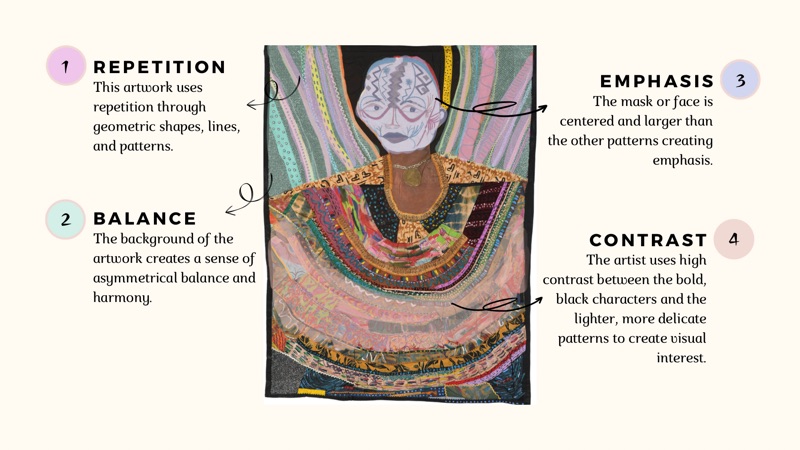
Contrast in design enhances visual impact through the interaction of light and dark, creating depth, drama, and focus. This balance guides attention, adds dimension, and strengthens the overall composition’s clarity and mood.
Emphasis


https://pin.it/HGB2L8ZV7 https://pin.it/2MeQHns9D
Emphasis attracts attention to certain elements by making them stand out through color, shapes and sizes within a composition. It ensures the viewer's focus is directed to key areas, enhancing the visual impact.
Balance


https://pin.it/2aMHwGn0h https://pin.it/2lpvZ3Tvs
Balance the distribution of visual weight in design is to ensure that some of the composition is not too heavy or light. It gives your design a sense of stability and harmony. There are three main types of balance: Symmetrical Balance, Asymmetrical Balance, Radial Balance.
Repetition

https://pin.it/7ztmmEsHt https://pin.it/58SDpI1U2
Repetition strengthens a design by creating rhythm. It involves repeating elements such as shapes, colors, patterns to create a visual connection.
Movement


https://pin.it/54vN7kxzc https://pin.it/6bu8IzF3z
Harmony and Unity ensure all design elements work together to create a balanced harmonious composition.
Symbol

https://pin.it/1f94KH9VG https://pin.it/4H97GM6Q5
Symbols are visual representations of ideas, concepts, or messages. They convey meaning and powerfully, often transcending language barriers.
Word and Image

Word and image combines text and visuals creates and enhance storytelling, communication, and impact in design.
"African Mephisto"

Pacita Abad's "African Mephisto" (1981) ,(106 x 71 in 269 x 180cm).
Pacita Abad's "African Mephisto" (1981). The vibrant representation of her distinctive style. This artwork illustrate her innovative trapunto technique, where she stitched and stuffed her painted canvases to create a three-dimensional, sculptural effect. The use of acrylic, rickrack ribbons, tie-dyed cloth, and painted cloth on a stitched and padded canvas showcases her diverse approach to materials. Pacita Abad's travels and interactions with art techniques and traditions heavily influenced her work. "African Mephisto" reflects this through its incorporation of cultural iconography and a rejection of Eurocentric ideals. The piece also embodies her interest in under-represented communities and her commitment to using art to document and memorialize events, fostering understanding. Moreover, this artwork highlights her broader artistic vision, which aimed to reach a wide audience by addressing themes of social responsibility and the immigrant experience. Her unique approach, which blends painting, textiles, and cultural elements, makes "African Mephisto" a powerful representation of her legacy.
feedback
Week 3 : Dr. Charles said my choice of picture as an example for the design principle is very textured and abstract. He loved it, found it very interesting and distinctive. He also mentioned that my choice of artwork, African Mephisto, would be a fascinating talking point and an interesting piece to discuss.